Addiction Medicine Programs


Continuing Education Credits

  • Most ECHO programs offer continuing education credits.

Important note about new DEA training requirements

In late December 2022, the DEA was required to implement a new Substance Use Disorder (SUD) training requirement for all DEA-registered providers; this has replaced the previous X-DEA waiver for buprenorphine prescribing for opioid use disorder.

Per the DEA letter, programs that teach “treatment and management of patients with opioid or other substance use disorders” will fulfill this requirement.

It is our assessment that most of Oregon’s Addiction Medicine ECHO Programs meet all the training requirements towards the 8 hours needed.
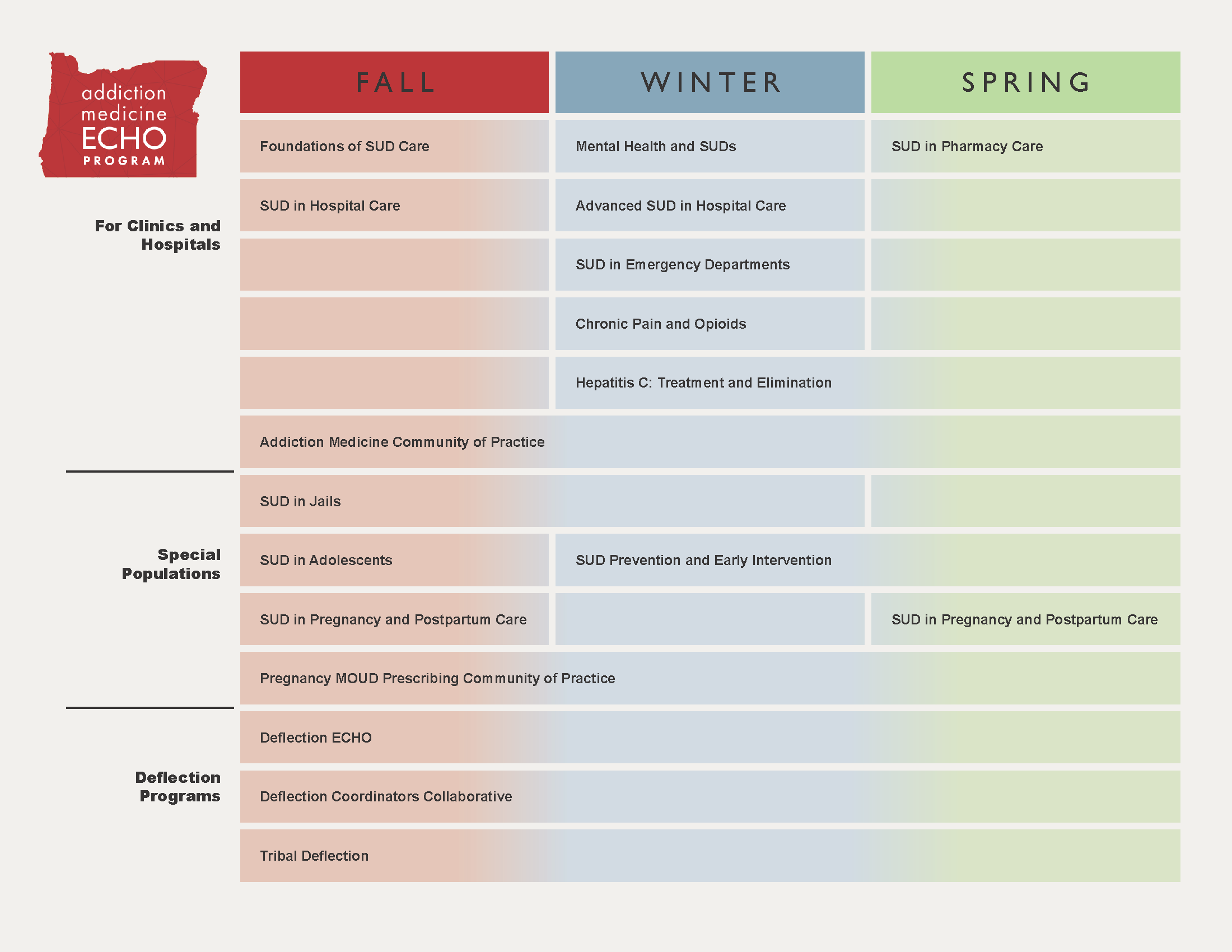

Foundations of Substance Use Disorder care I

Purpose: Support clinicians and their teams practicing in primary care clinics and other settings to identify and treat substance use disorders.

Audience: Prescribing clinicians, nurses, social workers, pharmacists, behavioral health clinicians, practice managers, and quality improvement specialists.

Sample topics: Neurobiology and diagnosis of substance use disorders; cannabis use disorder in primary care; chronic pain and opioids; building a sustainable system for SUD treatment.

Schedule: 11 sessions. Wednesdays, 12:00 - 1:00 p.m. PT, April 8 - June 17, 2026

Faculty:

  • Eleasa Sokolski, MD, Assistant Professor of Medicine and Psychiatry, OHSU; Addiction Medicine ECHO Deputy Director

  • Heather Starbird, LPC, Counselor, Mosaic Community Health

  • Sabrina F. Garcia, CRM II, THW, QMHA-II, CADC-R, CGRM, Prime + Supervisor, Peer Programs Manager/Engagment Coordinator, Transformations Wellness Center


Substance use disorders in Hospital Care

Purpose: Helping clinical teams build or improve systems of care that effectively treat addiction in hospital settings and emergency departments.

Audience: Hospitalists, physician assistants, nurse practitioners, ED providers, nurses, social workers, peers, case managers, pharmacists, care coordinators, quality improvement specialists, and other interested care team members are encouraged to register and forward to your colleagues and networks.

Sample topics: Medication for opioid use disorders; managing alcohol and methamphetamine use disorders in hospital care; overdose prevention; community SUD treatment settings; acute pain management in patients with SUD; trauma-informed care.

Schedule: 12 sessions. Wednesdays, 12:00 - 1:00 p.m. PT, April 1 — June 17, 2026

Faculty:

  • Honora Englander, MD, Professor of Medicine, Director Improving Addiction Care Team (IMPACT), OHSU

  • Emily Skogrand, PharmD, Pharmacist, Improving Addiction Care Team (IMPACT), OHSU

  • Amelia Goff, NP, Assistant Professor of Medicine, Improving Addiction Care Team (IMPACT), OHSU

  • Kathleen Young, BSN, RN, CARN, Infectious Diseases and Improving Addiction Care Team (IMPACT), OHSU

  • Syrrita Mason, CRMII, PSW, Peer Support Specialist, IMPACT Team, OHSU


Substance Use Disorder in Pregnancy and postpartum Care

Purpose:  Increase Substance Use Disorder (SUD) identification and treatment for prenatal and perinatal people, with a special focus on opioid use disorder and illicit non-pharmaceutical fentanyl.

Audience: People who work to support pregnant and postpartum people and their families including physicians, nurses including prescribing clinicians, nurses, social workers, pharmacists, nurse care managers, behavioral health specialists, administrators, and quality improvement specialists.

Sample topics: SUD and trauma-informed care in pregnancy; MOUD in pregnancy; developing safe discharge plans; DHS referrals, evaluation, and services; labor analgesia for the patient with OUD, trauma-informed urine drug testing.

Schedule: 12 sessions. Thursdays, 12:00 - 1:00 p.m., PT, April 9 - June 25, 2026

Faculty

  • Wendy J. Smith MD, MPH, OB/Gyn and Addiction Medicine, OHSU

  • Josh Reagan, MD, Obstetrics and Family Medicine, Providence

  • Gina Myers, CADC II, CRM, PSS, Counselor, Peer Mentor and Doula, Nurture Oregon, Reconnections Counseling

  • Teri Morgan, CADC-II, QMHA-II, Certified Narcan Training Instructor, Program Manager, Addictions Treatment, Marion County Health & Human Services


Deflection Peers & Navigators

Purpose: The purpose of the Deflection Peers and Navigators ECHO is to train and connect deflection team members who outreach, engage, and navigate services for participants in Oregon’s deflection programs. Deflection supervisors are encouraged to assign this ECHO as valuable training for their team members. This ECHO is produced by OHSU’s Deflection Implementation Technical Assistance team in collaboration with the Oregon ECHO Network. This ECHO is funded by the Oregon Criminal Justice Commission to support the Behavioral Health Deflection Grant Program.

Audience: Deflection navigators, peer support/wellness specialists, certified recovery mentors, outreach workers, engagement specialists, case managers, and peer supervisors. Deflection partner agencies providing behavioral health services are encouraged to join. For others involved in deflection please register for the general Deflection ECHO.

Sample Topics: Applying Principles of Forensic Peer Work to Deflection; Relationship Building with Law Enforcement; Peer Role as Part of a Multi-disciplinary Team; Person Centered Planning and Coordination of Care; Boundaries, Roles and Small Towns; Deflection Collaboration with the District Attorney (DA)

Schedule: First and third Tuesday of each month, 12:00 - 1:00 p.m., PT, April 7 - June 16, 2026

Faculty:

  • Dan Hoover, MD, Addiction Medicine ECHO Director, Jail MOUD Program TA Director, Deflection Implementation TA Director

  • Art Zamudio, CADCII, QMHA-II, CRM-II, Forensic Peer Endorsement, LEAD Supervisor, Ideal Option

  • John Karp-Evans, Deputy Director, The Peer Company

  • Isaiah O’Neil, CADC II , CRM II, QMHA I, Deflection Clinician/Recovery Services Program Supervisor, Clatsop Behavioral Healthcare


Chronic Pain and opioids

Purpose: Helping clinicians and their teams provide enhanced pharmacological and non-pharmacological treatment for chronic pain in medical settings.

Audience: Clinicians (prescribing MD, DO, NP, PA), nurses, social workers, pharmacists, behavioral health specialists, practice managers, and quality improvement specialists.

Sample topics: Pain education; Movement and pacing for chronic pain; Buprenorphine and pain; Recognize, diagnose, and treat mood disorders in; patients with chronic pain; Resiliency.

Schedule: 12 sessions. Tuesdays, 12:00 - 1:00 p.m. Pacific time, January 6 - March 31, 2026

Faculty:

  • Catriona Buist, PsyD, Assistant Professor of Anesthesiology and Perioperative Medicine, OHSU

  • Briana Susteric, MD, Associate Professor of Medicine, Division of General Internal Medicine & Geriatrics Section of AM, OHSU

  • Debra BuffaloBoy, CADCII, PWS, PSS; President of MHACBO board of directors; owner and administrator, Multicultural Consultants Limited; clinical peer supervisor

  • Erin Jobst, DPT, PhD, Associate Professor of Physical Therapy, OSU


Deflection ECHO

Purpose: The purpose of the Deflection ECHO is to connect Oregon teams to deflection experts, develop core skills for the deflection workforce, and function as a peer-to-peer networking space for Oregon’s deflection programs.

Audience: Deflection coordinators, case managers, certified recovery peers, law enforcement who interface with deflection teams, deflection SUD treatment partners, deflection community partners.

Program Goals: Showcase models of expanding deflection pathways and impact; Guide quality improvement for deflection programs; Train multidisciplinary staff for effective deflection encounters in the field; Build competency in navigating social services and behavioral health services; Promote awareness of substance use disorder medication treatments; Connect to share resources and success examples.

This ECHO is produced by OHSU’s Deflection Implementation Technical Assistance team in collaboration with the Oregon ECHO Network. This ECHO is funded by the Oregon Criminal Justice Commission to support the Behavioral Health Deflection Grant Program. Go to our comprehensive deflection TA page to access all resources we offer.

Schedule: Second Wednesdays, noon - 1 p.m., P.T., November 12, 2025 - June 10, 2026

Faculty:

  • Dan Hoover, MD, Deflection Implementation TA Director, OHSU

  • Chris Campbell, PhD, Associate Professor, Portland State University, Department of Criminology and Criminal Justice


Foundations of Substance Use Disorder care II

Purpose: Help clinicians and their teams practicing in primary care clinics and other settings to identify and treat substance use disorders (SUD). This ECHO introduces a systems perspective to providing SUD care and buprenorphine prescribing within primary care clinics.

Audience: Clinicians (prescribing MD, DO, NP, PA), nurses, social workers, pharmacists, behavioral health specialists, practice managers, and quality improvement specialists are encouraged to register. Primary care teams are highly encouraged to participate together including prescribers and other care team members.

Sample topics: Health disparities, stigma, and structural factors affecting addiction care; Use of long-acting injectable buprenorphine; How to address co-occurring mental health disorders; Pregnant patients and SUD; Palliative care and SUD.

Schedule: 12 sessions. Wednesdays, 12:00 - 1:00 p.m., Pacific time, January 7 - April 1, 2026

Faculty:

  • Eleasa Sokolski, MD, Assistant Professor of Medicine and Psychiatry, OHSU; Addiction Medicine ECHO Deputy Director

  • Stacie Andoniadis, BS, Program Manager, Medication for Addiction Treatment, CareOregon

  • Lydia Bartholow, PMHNP, CARN-PA, FIAAN, Medical Director of Substance Use Disorder Services at Unity Behavioral Health, Associate Professor UCSF SON, Assistant Professor OHSU SOM and SON

  • Heather Starbird, LPC, Counselor, Mosaic Community Health


Substance Use Disorder Prevention and early intervention

This ECHO is currently full. You may still register, but may be placed on a waitlist.

Purpose: This ECHO is focused on substance use prevention and early intervention systems in school contexts. Prevention work is complex, interprofessional, and requires strong partnerships. Sessions will exemplify successful models, empower teams to vision together, and assist champions to advance their own prevention efforts.

Audience: School counselors, teachers, coaches, athletic directors, school-based health professionals, school administrators, youth services officers, youth behavioral health professionals, youth peer support, public health professionals, juvenile justice professionals.

Sample topics: Evidence-Based Early Intervention; Universal and Culturally Specific Screening; School-Community Prevention Partnerships; Youth Peer Support Models; Family-Integrated Screening and Early Intervention; Collaboration and Leveraging Cross-Sector Funding.

Schedule: Alternating Thursdays, 4:00-5:00 p.m., Pacific time, January 22 - June 25, 2026.

Faculty:

  • Rae Wright, MD, Family Medicine, Addiction Medicine Specialist

  • Jenny Cary, LCSW, Mental and Behavioral Health Coordinator, Hillsboro School District

  • Mike McCart, Ph.D., Senior Research Scientist, Oregon Social Learning Center (OSLC)

  • Ashley Silver, CADC-I, QMHA, Specialized Behavioral Health Support Specialist, La Clinica School Based Health Center


Substance Use disorders in Emergency Departments

Purpose: Improve services provided to people with substance use disorder accessing emergency departments for care. Throughout ECHO, we address clinical care, patient and provider experience, and stigma towards people who use drugs. Interprofessional faculty includes physicians, social workers, and peers.

Audience: ED clinicians (prescribing MD, DO, NP, PA), nurses, social workers, pharmacists, behavioral health specialists, practice managers, and quality improvement specialists are encouraged to register. ED teams are highly encouraged to participate together including prescribers and other care team members.

Sample topics: Reducing stigma and using best practice language for substance use disorder care; Medication for Opioid Use Disorder, including buprenorphine and methadone; Management of precipitated opioid withdrawal; Managing alcohol withdrawal; Methamphetamine Use Disorder; Recovery Peers in emergency departments.

Schedule: 12 sessions. Tuesdays, 12:00 - 1:00 p.m., Pacific time, February 10 — May 5, 2026

Faculty

  • Ulrika Agnew, MD, Emergency Department/ Addiction Medicine Clinician, Astoria Sunnyside Hospital; Boulder Care

  • Melissa Willitzer, PA-C, Emergency Department Clinician, OHSU Hillsboro; Portland Adventist; and Columbia Memorial Hospital

  • Shaun Babcock, MSW, Medical Social Worker, Tuality

  • Brennan Washburn, CADC-R. CRM I, PSS, Bend Peer Supervisor and Peer Support Specialist, BestCare Treatment Services


Substance Use disorders in jails

Purpose: Learn and share emerging best practices in the areas of substance use disorders and foster community among a group of jail administrators and healthcare providers.

Audience: Jail administrators, jail healthcare staff, and community healthcare providers.

Sample topics: Neurobiology and the chronic disease model of SUD; understanding MOUD program design and evidence in corrections; corrections officers in MOUD and SUD services; The Medicaid 1115 Waiver and carceral settings; recovery peers; planning for release.

Schedule: 13 sessions. First and third Tuesdays, 12:00 - 1:00 p.m., PT, September 16, 2025 - April 7, 2026

Faculty

  • Daniel Hoover, MD, Assistant Professor of Medicine, OHSU; Addiction Medicine ECHO Director

  • Melanie Menear, MHA, MSN, RN CCHP, Healthcare Administrative Services Manager, Clackamas County Jail

  • Edward Buntin, Lieutenant, Kittitas County Jail

  • Amber Potter, CRM II, Peer Recovery Mentor, MHAAO

  • Amber Chaney, Operations and Policy Analyst, OHA Reentry Health CareProgram


Methadone for Carceral Facilities community of practice

Purpose:  The purpose of this ECHO is to share administrative and clinical practices for delivering methadone services within carceral facilities. The ECHO will connect Northwest carceral facility staff and healthcare teams, and is also open to national participation. This program is funded by Oregon’s Opioid Settlement Prevention Treatment and Recovery Board.

Audience: Carceral facility administrators, program managers, healthcare staff, pharmacists, release planners, community healthcare providers, and opioid treatment programs.

Schedule: 9 sessions. Third Thursdays, 12:00 - 1:00 p.m., PT, October 16, 2025 - June 18, 2026

Faculty

  • Matt West, DO, OHSU Jail MOUD TA Team; Addiction Medicine Medical Director, Clark County Jail

  • Eowyn Rieke, MD, MPH, FASAM, Addiction Medicine Physician, Multnomah County Department of Health/Corrections Health


Communities of Practice

Addiction Medicine communities of practice are designed for those who have attended Addiction Medicine ECHO programs to come together and present their challenging cases for a facilitated discussion in an informal setting. These programs meet monthly and do not offer didactic presentations; they are 100% case-based. Learners receive CME credits for attendance.


Addiction Medicine Community of Practice

Audience: Primary care clinicians, hospital clinicians, pediatricians treating adolescents, clinicians treating pregnancy, jail healthcare personnel, and other healthcare professionals. Recommended for graduates of Foundations of Substance Use Disorder Care I and II, Substance Use Disorders in Hospital Care, Chronic Pain and Opioids. SUD in Pregnancy, SUD in Jails.

Schedule: 10 Sessions. Second Monday of each month, 12:00 - 1:00 p.m., PT, September 8, 2025 - June 8, 2026


HEPATITIS C COMMUNITY OF PRACTICE

Audience: Healthcare professionals caring for patients with Hepatitis C and other liver diseases. Simultaneous enrollment in this community of practice is strongly recommended for those enrolling in the foundational Hepatitis C: Treatment and Elimination ECHO and also recommended for past graduates of Hepatitis C Treatment and Elimination.

Schedule: 9 sessions, first Monday of each month, 12:00 - 1:00 p.m. PT, October 6, 2025 - June 1, 2026